
Role of carbonation in flavour experience: bubbles, bite and beyond

Carbonation reshapes a beverage’s sensory profile by reducing perceived sweetness, amplifying sour and tactile bite, and fundamentally altering mouthfeel — so a drink’s flavour is as much about bubbles as it is about ingredients.
Three sensory outcomes follow almost every time CO2 enters the picture:
- Sweetness drops. Behavioural and fMRI studies show that carbonation suppresses sweetness perception for both natural and artificial sweeteners, meaning a carbonated drink tastes less sweet than its still counterpart at identical sugar concentrations.
- Sourness and bite rise. CO2 dissolves in saliva to form carbonic acid, activating sour-sensing taste cells and trigeminal nociceptors simultaneously — the result is that characteristic tingle and sharpness.
- Mouthfeel shifts. Bubbles alter oral lubrication, increase friction between tongue and palate, and change how tastants flow to receptors, producing a drier, more textured sensation than still liquids.
The mechanism behind these effects lives in the physiology section below. Formulators and product developers will want to read the sections on flavour chemistry, mouthfeel physics, and formulation variables. Consumers curious about health implications will find a focused summary near the end.
Table of Contents
- How your mouth actually detects CO2
- How carbonation shifts sweetness, sourness, bitterness and astringency
- What bubbles actually do to mouthfeel
- How carbonation changes aroma and what sound has to do with it
- Low, medium and high carbonation: what each profile actually delivers
- Formulation and packaging variables that interact with carbonation
- What the research actually shows: key studies and measured correlations
- Is carbonation bad for you? What the evidence says
- Practical tips for shaping flavour with carbonation
- Key takeaways
- Why carbonation science deserves more respect from formulators
- Drinksolidviibe: sparkling beverages built around these principles
- Useful sources
How your mouth actually detects CO2
The tingle from a sparkling drink is not simply the pop of bubbles on your tongue. The primary biological mechanism is chemical: CO2 dissolves in saliva to form carbonic acid, and that acid activates a specific protein called carbonic anhydrase 4 (Car4) located in sour-sensing taste cells. Car4 acts as the principal oral CO2 sensor, converting dissolved CO2 into protons that directly stimulate those cells. The result registers in the brain as a mild acidity — which is why sparkling water tastes faintly sour even without any added acid.

Beyond taste cells, CO2 also triggers the trigeminal nerve, the same sensory pathway responsible for the burn of chilli or the cool of menthol. Critically, trigeminal carbonation sensation persists even when bubbles are physically suppressed, confirming that the “bite” is chemogenic — driven by carbonic acid chemistry — rather than purely mechanical bubble-burst pressure. This distinction matters for formulators: you cannot remove the bite simply by reducing bubble size.
The full carbonation experience is built from at least three overlapping signals. Gustation (taste cells detecting carbonic acid), somatosensation (trigeminal irritation producing tingle and mild pain), and multisensory cues including the visual sparkle and auditory fizz all converge in the brain to produce what we call “carbonation.” A simplified pathway looks like this: dissolved oral CO2 → carbonic acid formation → Car4 activation in sour cells + nociceptor stimulation → parallel signals through the gustatory and trigeminal cortex → integrated perception of sourness, tingle, and bite.
Pro Tip: If you are developing a low-acid sparkling beverage and want to reduce perceived bite without losing effervescence, consider that the bite comes primarily from carbonic acid chemistry, not bubble count. Adjusting pH with a buffering agent can soften the sour signal without requiring you to degas the product.
How carbonation shifts sweetness, sourness, bitterness and astringency
The impact of carbonation on flavor is directional and measurable across all four of the primary taste attributes most relevant to beverage formulation.
Sweetness is consistently suppressed. Both behavioural tasting panels and fMRI imaging show reduced neural gustatory responses to sweet stimuli when CO2 is present. The practical consequence: a carbonated version of a recipe will taste less sweet than the still version at the same sugar level, so formulators typically need to increase sweetener concentration to compensate when carbonating a formula.
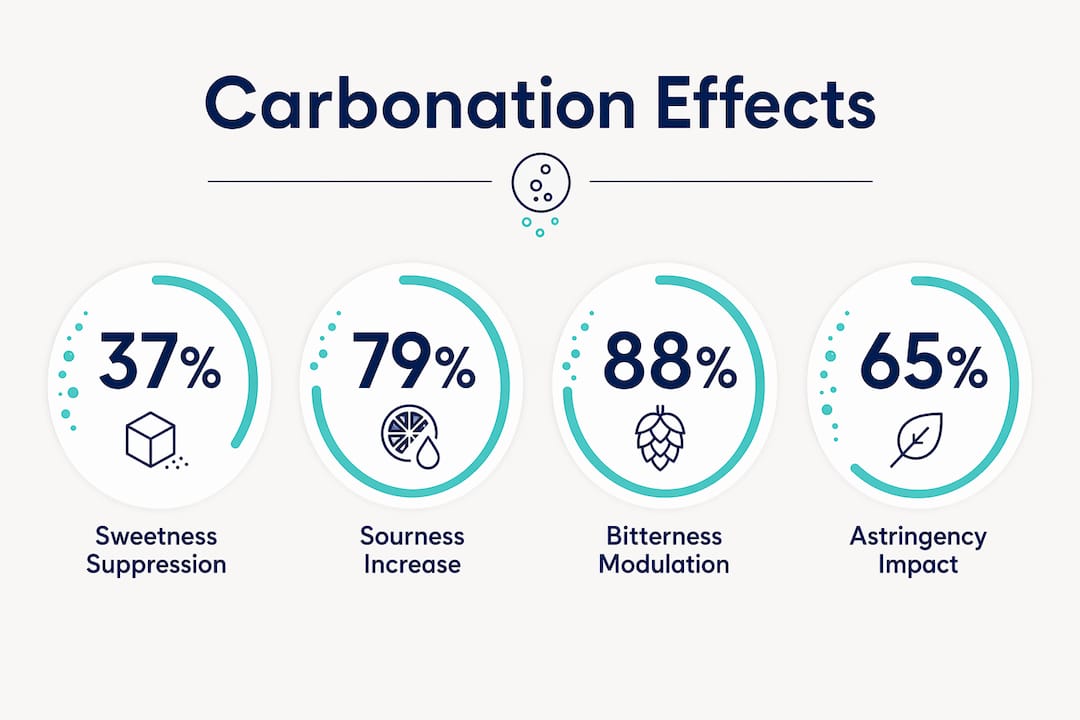
The other three attributes move in predictable directions, supported by a sensory study that reported clear correlation coefficients:
- Sourness increases (r = 0.79 correlation with carbonation level), consistent with carbonic acid formation activating sour-sensing pathways.
- Astringency decreases (r = −0.82), likely because CO2 alters the interaction between tannins or polyphenols and salivary proteins.
- Bitterness decreases (r = −0.88), suggesting that carbonation partially masks bitter compounds, possibly through the same lubrication and receptor-access changes described in the mouthfeel section.
These sensory correlations have a direct formulation implication. A still herbal tea that tastes pleasantly bitter and astringent may taste sour and flat when carbonated at the same formula. The fix is not simply adding CO2 — it is rebalancing acid, sweetener, and bitter compounds together.
Carbonation’s sweetness suppression is a double-edged effect. It can be genuinely useful for masking the metallic or chemical aftertaste of artificial sweeteners in diet beverages, because the tingle and sourness distract from lingering off-notes. The risk, as researchers note, is that consumers may perceive the drink as lower in sugar than it actually is, potentially encouraging higher intake to satisfy sweetness expectations.
What bubbles actually do to mouthfeel
Mouthfeel in a carbonated beverage is not just about the pleasant tickle of effervescence. The physics of bubble nucleation and CO2 behaviour in the mouth produce measurable changes in oral lubrication and friction that directly affect how a drink feels — and how its flavours reach your receptors.
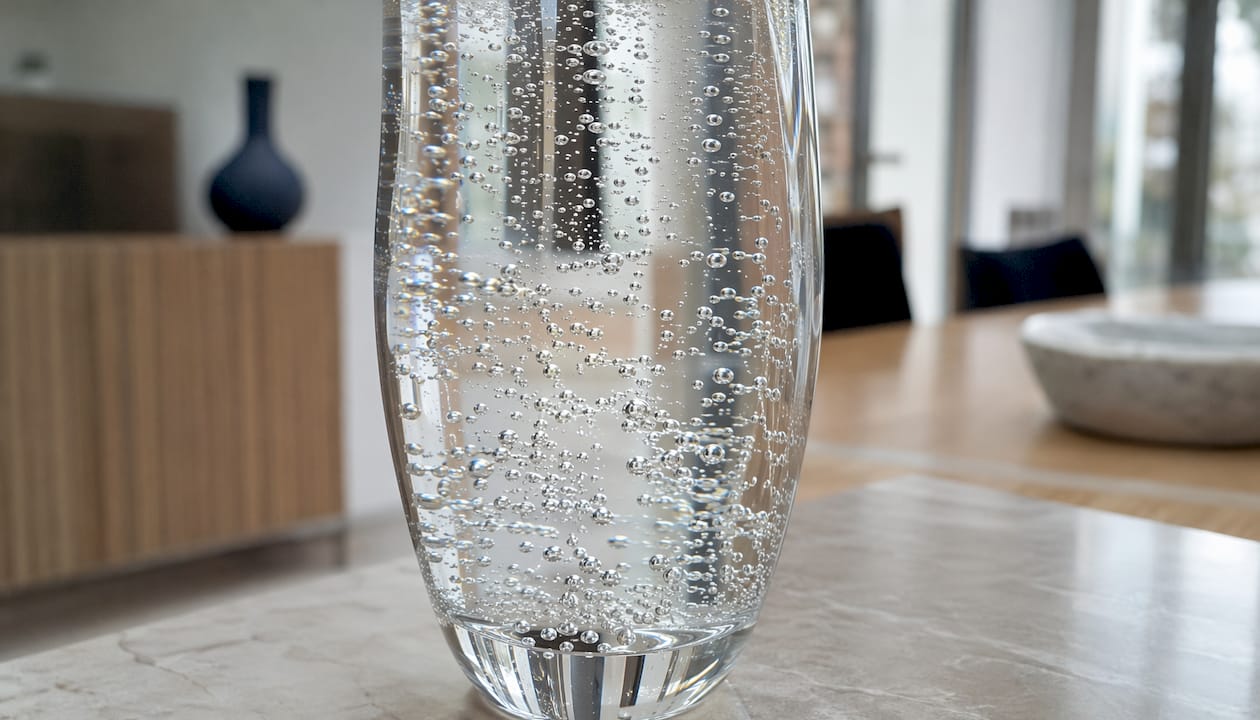
Bubbles nucleate at microscopic surface imperfections in a glass or on the tongue, grow as dissolved CO2 migrates into them, and eventually detach and burst. Smaller, more uniform bubbles tend to produce a finer, creamier texture; larger, irregular bubbles create a coarser, more aggressive bite. Bubble size is influenced by carbonation pressure, temperature, and the presence of surface-active compounds like proteins or polysaccharides in the liquid.
The lubrication story is where things get genuinely counterintuitive. Tribology experiments show that carbonated water increases friction in tongue-palate contact, with CO2 capable of debonding salivary pellicle proteins from oral surfaces and reducing the protective film that normally keeps the mouth feeling smooth. Trapped CO2 cavities obstruct the liquid film, reduce its thickness, and leave the palate feeling drier and rougher than still water would. This is why highly carbonated beverages often feel “drying” despite being liquid.
That friction increase has a secondary flavour effect: when the salivary pellicle is disrupted, the flow of tastants to taste receptors changes. Some compounds reach receptors more readily; others are partially blocked. The net result is that the same flavour molecules can register differently in a carbonated matrix than in a still one.
Pro Tip: Serving temperature has a direct effect on bubble behaviour. Colder liquids hold CO2 in solution more effectively, producing finer, more persistent effervescence. Warmer temperatures accelerate CO2 release, creating larger, faster-dissipating bubbles and a coarser mouthfeel. For a smoother texture, serve at 4–6°C; for a more assertive bite, let the drink warm slightly before tasting.
How carbonation changes aroma and what sound has to do with it
Aroma is where the role of bubbles in flavour gets genuinely surprising. Bubbles act as tiny transport vehicles for volatile aromatic compounds, carrying them from the liquid to the headspace above the glass. This means a carbonated beverage can release more aroma before you even take a sip — the rising bubbles continuously strip volatiles from the liquid and deposit them at the surface.
Once you start drinking, the picture gets more complex. Research on aroma release shows that CO2 can both enhance the release of some volatile compounds and decrease in-vivo aroma delivery during consumption. Aroma intensity in the headspace before the sip is not a reliable predictor of what you actually smell retronasally during drinking. Some volatiles that appear strongly in the glass aroma are partially suppressed in-mouth, while others are amplified. This makes sensory prediction from headspace analysis alone unreliable for carbonated products.
Bubble size and foam stability are key drivers of this aroma release dynamic. Finer, more stable bubbles produce a more sustained and even volatile release; coarse, rapidly dissipating bubbles dump volatiles in a short burst that fades quickly. For sparkling wines and craft sodas, this is why bubble quality is treated as a proxy for overall sensory quality.
Sound and sight matter more than most people expect. Consumer research consistently finds that the fizz sound and visual sparkle prime expectations before the first sip, influencing perceived intensity and freshness. A few practical implications:
- Glassware shape affects both aroma concentration and auditory cues. A narrower opening concentrates headspace aroma and amplifies the fizz sound, priming a more intense sensory expectation.
- Pour angle and height influence bubble formation and foam, which in turn affect both aroma release and the visual and auditory signals that set expectation.
- Serving in a chilled glass preserves CO2 longer, sustaining both the visual sparkle and the aromatic lift throughout the drink.
Low, medium and high carbonation: what each profile actually delivers
Carbonation level is one of the most powerful formulation levers available, yet it is often treated as a fixed parameter rather than a deliberate sensory choice. Each level produces a distinct profile.
Low carbonation (gentle effervescence, minimal bite) softens sourness, preserves more of the original sweetness profile, and produces a smooth, almost creamy mouthfeel. Astringency and bitterness come through more clearly because carbonation’s masking effect is reduced. This profile suits beverages where the base flavour complexity should lead — lightly sparkling waters, delicate botanical drinks, and products where a gentle mouthfeel is the priority. Serve slightly cooler than room temperature in a wide glass to let aroma open up.
Medium carbonation strikes the balance most consumers associate with refreshment. Sweetness suppression is moderate, sourness is noticeable but not sharp, and the mouthfeel has texture without being aggressive. This is the profile that works across the widest range of flavour bases — fruit-forward sodas, sparkling teas, and functional beverages where both flavour and sensation need to coexist. A tall, narrow glass helps sustain carbonation through the drink.
High carbonation is assertive. Sweetness is significantly suppressed, sourness and tingle dominate, bitterness and astringency are masked, and the mouthfeel is dry and textured. The strong bubble-driven volatile release means aroma hits hard in the glass before the sip. This profile suits beverages with bold, simple flavour profiles that can hold their own against the CO2 — classic colas, sparkling mineral waters, and products where the bite itself is part of the appeal. Serve very cold to control bubble size and prevent excessive CO2 loss.
A few practical pairing notes:
- Citrus-forward flavours tend to amplify well at medium-to-high carbonation because the sourness from CO2 reinforces the natural acidity.
- Delicate floral or herbal notes are better preserved at low carbonation, where the trigeminal interference is minimal.
- Bitter compounds (hops, botanicals, tea tannins) are most perceptible at low carbonation; high CO2 will largely mask them.
Formulation and packaging variables that interact with carbonation
Getting carbonation right in a finished product requires managing several variables beyond CO2 volume. Each one affects how the sensory profile lands on the consumer.
pH and acid balance are the most direct interaction. CO2 itself lowers the pH of a beverage by forming carbonic acid, so the starting pH of your formula shifts downward when carbonated. Citric acid, a common acidulant, interacts with this shift — understanding citric acid’s role in beverage stability and taste helps formulators set the right buffer before carbonation is added. Buffering capacity matters: a formula with low buffering will show a larger pH drop under CO2 than a well-buffered one, amplifying sourness more than intended.
Sugar versus sweetener behaviour under CO2 differs. Sucrose is relatively stable in carbonated matrices; many high-intensity sweeteners are more sensitive to pH shifts and may degrade faster in a lower-pH carbonated environment. Carbonation’s sweetness-suppression effect also hits artificial sweeteners differently than sucrose, which is relevant when formulating reduced-sugar products.
Headspace and packaging directly affect CO2 retention. Key considerations for small-batch and craft producers in Canada:
- Minimise headspace in cans and bottles to reduce CO2 migration into the gas phase before sealing.
- Aluminium cans outperform PET bottles for CO2 retention over shelf life; glass sits between the two.
- Closure integrity is critical — even minor seal defects cause measurable CO2 loss within weeks.
- Kegging (common in Canadian small-batch production) maintains CO2 under continuous pressure, preserving sensory profile better than open-pour packaging for on-tap service.
Shelf-life and stability are directly tied to CO2 loss. As carbonation drops over shelf life, the sensory profile shifts: sweetness perception rises, sourness decreases, and mouthfeel becomes smoother. A product that tastes well-balanced at packaging may taste flat and overly sweet by the end of its shelf life. Accelerated shelf-life testing under realistic temperature conditions is the most reliable way to predict this drift.
The role of natural ingredients in formulation also intersects with carbonation stability. Some natural flavour compounds are volatile and may be preferentially stripped by rising bubbles during shelf storage, accelerating aroma fade.
What the research actually shows: key studies and measured correlations
The sensory effects described throughout this article are not speculative — they are grounded in peer-reviewed evidence. Here is a concise summary of the principal findings.
Sweetness suppression is the most replicated finding. The PMC review on carbonation’s role in taste synthesises both behavioural tasting data and fMRI evidence showing reduced neural gustatory responses to sweet stimuli in the presence of CO2. The effect holds for both sucrose and artificial sweeteners.
Sensory correlations from a dedicated sensory study provide the clearest numeric picture:
| Sensory attribute | Correlation with carbonation level | Direction |
|---|---|---|
| Sourness | r = 0.79 | Increases with carbonation |
| Astringency | r = −0.82 | Decreases with carbonation |
| Bitterness | r = −0.88 | Decreases with carbonation |
These figures come from the MDPI bubbles and foam review, which also identifies bubble size and foam stability as key drivers of aroma and sensory acceptance.
Tribology findings from the ScienceDirect study show that carbonated water produces a measurable increase in friction under tongue-palate contact conditions, with CO2 debonding salivary pellicle proteins and reducing oral lubrication. The oral lubrication study provides the mechanistic basis for the drying mouthfeel associated with highly carbonated beverages.
Consumer texture descriptors from focus-group research found that cooling, carbonation, and bite were among the most frequently cited texture attributes for carbonated beverages, with cooling cited by 93.3% of participants, carbonation by 86.7%, and bite by 83.3%.
Open questions and limitations the research acknowledges:
- Most studies use simple model beverages (carbonated water, sucrose solutions) rather than complex commercial matrices, so real-product effects may differ.
- Population differences in trigeminal sensitivity and Car4 expression are not well characterised, meaning individual variation in carbonation perception is likely larger than current studies capture.
- In-vivo aroma delivery under carbonation remains an active research gap; headspace measurements do not reliably predict retronasal experience.
- Long-term behavioural effects of sweetness suppression (compensatory intake) need larger, controlled studies.
Is carbonation bad for you? What the evidence says
The short answer is that moderate carbonated beverage consumption is generally well-tolerated for most people, but a few specific concerns deserve honest attention.
Dental erosion is the most evidence-supported concern. Carbonic acid lowers the pH of a beverage, and repeated acid exposure can contribute to enamel erosion over time. Plain sparkling water has a much lower erosion risk than carbonated beverages with added citric acid or phosphoric acid. The health considerations for sparkling water are meaningfully different from those for acidified sodas — the two categories should not be conflated.
Gastric distension and satiety are real, short-term effects. Carbonation creates gastric distension that can induce fullness signals, which may reduce appetite in the short term. Whether this translates to meaningful long-term intake reduction is not established.
Sweetness suppression and compensatory intake is a legitimate concern for diet beverages. If carbonation masks the perceived sweetness of an artificially sweetened drink, consumers may drink more to satisfy sweetness expectations, partially offsetting the calorie reduction.
A few evidence-based points for consumers:
- Plain sparkling water poses minimal dental risk compared to acidified carbonated drinks.
- Carbonated beverages consumed with meals may contribute to short-term satiety via gastric distension.
- People with gastroesophageal reflux disease (GERD) or irritable bowel syndrome (IBS) often report worsened symptoms with high carbonation; individual tolerance varies.
- The concern about carbonation reducing bone density is not well-supported by evidence for plain sparkling water; the association in older studies was primarily with cola drinks containing phosphoric acid.
This article provides general information on carbonation and sensory science, not medical or dietary advice. Consult a qualified health professional for guidance specific to your situation.
Practical tips for shaping flavour with carbonation
Whether you are making craft soda at home or developing a small-batch sparkling beverage for the Canadian market, carbonation is a variable you can control deliberately.
Do/Don’t checklist:
- Do taste your base formula still before carbonating — it is the only way to know your starting sweetness, sourness, and bitterness baseline.
- Do increase sweetener concentration slightly when carbonating, since CO2 will suppress perceived sweetness.
- Do chill your beverage before carbonating; colder liquid absorbs and retains CO2 more efficiently.
- Don’t assume a formula that tastes balanced still will taste balanced carbonated — the sensory profile will shift.
- Don’t over-acidify before carbonating; carbonic acid will add its own sourness on top of any citric or malic acid already present.
- Don’t ignore headspace when bottling; excess headspace accelerates CO2 loss and flavour drift.
Home and small-scale equipment available in Canada: Countertop soda makers (widely available at Canadian kitchen retailers) use standard CO2 cylinders and allow you to carbonate at home. CO2 chargers (small cartridges used with whipping siphons) work for small-volume experiments. For small-batch production, draft kegging systems using food-grade CO2 regulators are available through Canadian homebrew supply shops and restaurant equipment suppliers. Always follow manufacturer safety guidelines for pressurised CO2 equipment — cylinders must be stored upright, secured, and away from heat sources.
A simple recipe tweak for a less sharp craft soda: If your carbonated soda tastes too sharp or sour, the fix is usually not less CO2 — it is more buffering in the base. Try increasing the ratio of a milder acid (such as malic) relative to citric, or add a small amount of sodium bicarbonate to raise the base pH slightly before carbonating. The result is a softer, rounder sourness rather than a sharp bite.
Quick flavour-check experiment:
- Prepare a single batch of your base liquid (unsweetened or lightly sweetened).
- Taste a small amount still and note perceived sweetness, sourness, and mouthfeel on a simple 1–5 scale.
- Carbonate the remainder and taste immediately at the same temperature.
- Note the differences: sweetness should drop, sourness should rise, mouthfeel should feel drier.
- Adjust your formula — add sweetener if sweetness is too low, reduce acid if sourness is too sharp — then repeat the comparison.
This two-step still-versus-carbonated tasting is the fastest way to calibrate a formula before committing to a full batch. For a deeper look at how acidity perception works across beverage categories, the coffee acidity guide from Tri Crow Coffee offers a useful cross-category perspective on how acid balance shapes overall flavour.
Key takeaways
Carbonation’s role in flavour experience is mechanistic and measurable: CO2 suppresses sweetness, amplifies sourness, and alters mouthfeel through carbonic acid chemistry and oral lubrication changes that no amount of ingredient adjustment alone can replicate.
| Point | Details |
|---|---|
| Sweetness is suppressed | Carbonation reduces perceived sweetness for both natural and artificial sweeteners; increase sweetener concentration to compensate. |
| Sourness and bite increase | CO2 forms carbonic acid, activating Car4 in sour cells and trigeminal nociceptors; r = 0.79 correlation between carbonation level and sourness. |
| Mouthfeel becomes drier | CO2 debonds salivary pellicle proteins and increases oral friction, producing a drier, more textured sensation. |
| Aroma is unpredictable | Headspace aroma before the sip does not reliably predict in-mouth retronasal delivery; bubble quality shapes volatile release. |
| Drinksolidviibe applies these principles | Drinksolidviibe’s sparkling beverages use natural ingredients and functional flavours calibrated to work with carbonation’s sensory effects, not against them. |
Why carbonation science deserves more respect from formulators
Most beverage development conversations treat carbonation as a finishing step — you build the flavour, then you add the bubbles. After spending time with the research behind this article, that approach looks backwards.
The correlations between carbonation level and sourness, astringency, and bitterness are not subtle. An r = −0.88 relationship between carbonation and bitterness means that a formula’s bitter character is largely determined by how much CO2 it carries. Formulators who set their acid and sweetener levels in a still base and then carbonate are essentially designing for a product that does not exist yet. The carbonated version is a different beverage.
What strikes me most is the trigeminal dimension. The bite from carbonation is not a texture add-on — it is a chemogenic pain signal, the same neural pathway that registers chilli heat. Consumers who describe a sparkling drink as “refreshing” are partly responding to a mild nociceptive stimulus. That is a remarkable thing to build into a beverage, and it explains why carbonation is so hard to replicate with other ingredients. You cannot swap in a flavour compound and get the same result because the sensation is neurological, not chemical in the conventional taste sense.
The aroma complexity is equally underappreciated. The finding that headspace aroma before the sip does not predict in-mouth retronasal delivery means that sensory evaluation of carbonated products needs to happen in-vivo, not just in a glass. A sparkling beverage that smells extraordinary on the pour may deliver a muted aroma experience during drinking, and vice versa. For anyone serious about flavour design in sparkling beverages, that gap between pre-sip and in-mouth aroma is where the most interesting formulation work lives.
Drinksolidviibe: sparkling beverages built around these principles
Understanding how carbonation reshapes flavour is one thing. Building a product around it is another. Drinksolidviibe’s sparkling beverages are formulated with natural ingredients and functional flavours — lemon-ginger, peach, and passionfruit — chosen specifically because they hold up under carbonation’s sensory effects rather than being overwhelmed by them. The citrus and ginger notes in the lemon-ginger variant, for instance, work with the sourness amplification that CO2 produces rather than fighting it, while the natural sweetness is calibrated to account for the suppression effect.
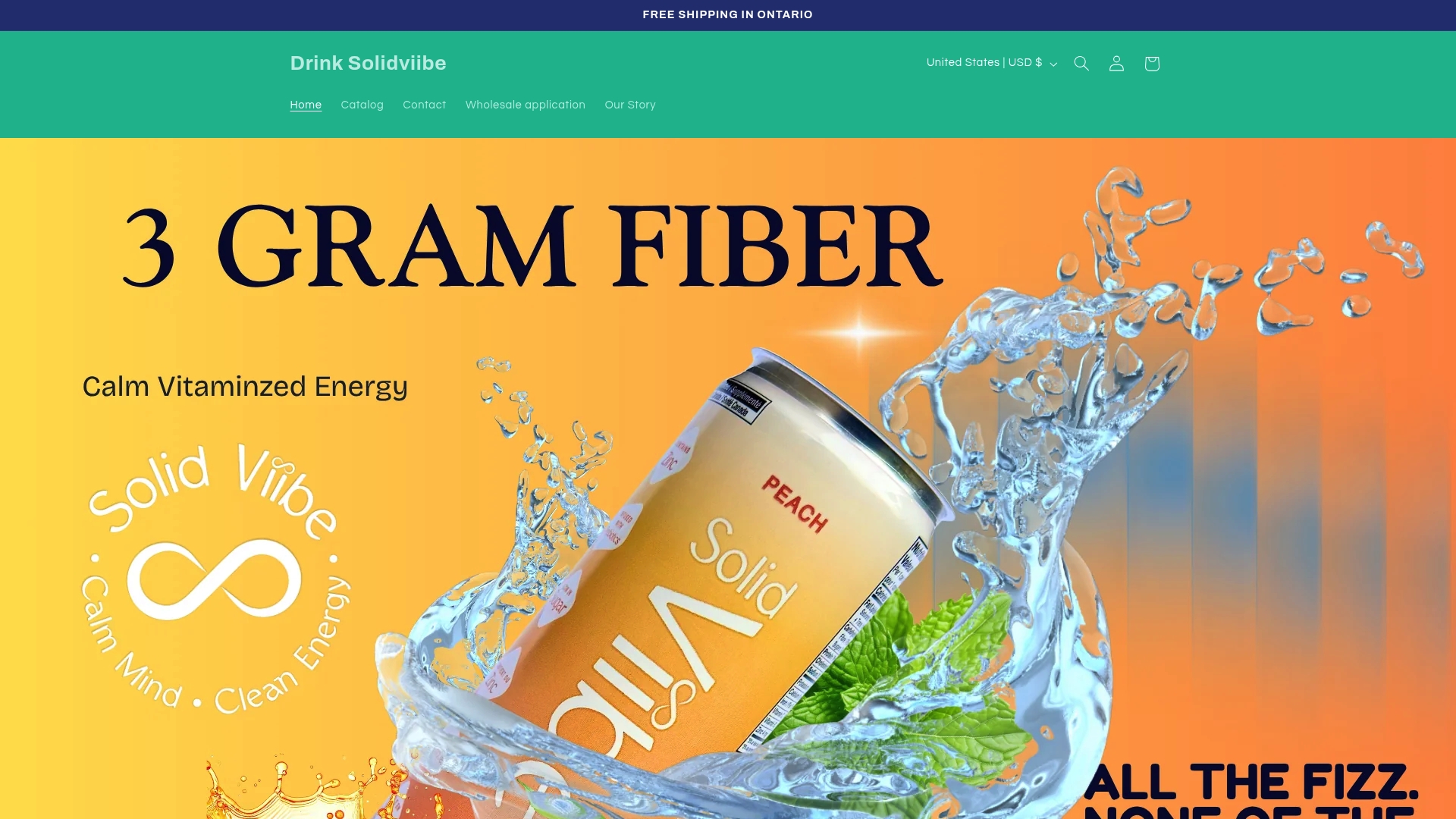
Available across Canada, Drinksolidviibe offers a healthier alternative to sugary sodas without sacrificing the sensory complexity that makes a sparkling drink satisfying. If you want to experience how thoughtful carbonation and flavour calibration actually feel in a glass, the variety pack gives you all three flavour profiles side by side — a practical way to taste the principles this article describes.
Useful sources
Primary studies and reviews cited in this article, with a note on their relevance:
- In Search of a Role for Carbonation: Is This a Good or Bad Taste? (PMC) — The most comprehensive review of carbonation’s sensory effects; primary source for sweetness suppression evidence, satiety effects, and the double-edged sweetener masking insight.
- Carbonic anhydrase 4 and CO2 sensing (Science) — Molecular identification of Car4 as the principal oral CO2 sensor in sour-sensing taste cells; foundational for the mechanism section.
- Bubble-bursting vs chemogenic origins of carbonation sensation (PLOS ONE) — Psychophysical evidence that trigeminal carbonation sensation persists without bubble bursting, establishing the chemogenic origin of the bite.
- Bubbles, foam formation, stability and consumer perception of carbonated drinks (MDPI) — Industry review providing the sourness, astringency, and bitterness correlation coefficients and bubble/foam dynamics data used throughout.
- Effects of beverage carbonation on lubrication mechanisms and mouthfeel (ScienceDirect) — Tribology study demonstrating CO2’s effect on oral friction, salivary pellicle debonding, and mouthfeel; primary source for the lubrication section.
- Multisensory aspects of taste and flavour perception (PMC) — Review establishing the multisensory nature of carbonation experience, integrating taste, somatosensation, and auditory/visual cues.
- Carbonation perception and texture characteristics (Foods, MDPI) — Consumer focus-group and free-sorting study providing texture descriptor frequencies (cooling 93.3%, carbonation 86.7%, bite 83.3%).
- Wiley aroma release and carbonation research — Published research on the complex interaction between CO2 and volatile release, establishing that headspace aroma does not reliably predict in-vivo retronasal delivery.


