
Phytonutrient beverages: what they are and why they matter

Phytonutrient beverages are drinks derived from plants that supply bioactive compounds promoting health through antioxidant and anti-inflammatory effects. These are not vitamins or minerals in the traditional sense. They are a separate class of plant compounds that your body uses to neutralise oxidative stress, modulate immune responses, and reduce the kind of cellular damage linked to chronic disease. The most familiar examples sit in your kitchen right now:
- Green tea — rich in catechins, particularly epigallocatechin gallate (EGCG)
- Black tea — contains theaflavins and thearubigins from oxidised flavan-3-ols
- Coffee — one of the most concentrated dietary sources of chlorogenic acids
- 100% fruit juice — delivers anthocyanins, carotenoids, and phenolic acids depending on the fruit
- Powdered phytonutrient mixes — concentrated plant extracts designed for potent antioxidant delivery
What sets phytonutrient beverages apart from plain hydration is that the plant compounds they carry do biological work once absorbed. That distinction is worth keeping in mind as you read through what follows.
What beverages are naturally high in phytonutrients?
Green tea, black tea, coffee, and 100% fruit juices are the most widely consumed natural phytonutrient sources, and they are also among the most studied. Beyond those four, a handful of other options deserve attention:
- Pomegranate juice — exceptionally high in punicalagins, a class of ellagitannins with strong antioxidant activity
- Purple grape juice — a source of resveratrol and anthocyanins, the same compounds associated with red wine’s studied benefits
- Grapefruit juice — contains naringenin, a flavanone linked to metabolic and cardiovascular research
- Hibiscus tea — delivers anthocyanins and organic acids; hibiscus berry blends have become a popular way to access these compounds
- Carrot and tomato juice — among the richest beverage sources of carotenoids, including beta-carotene and lycopene
- Functional mushroom coffee — an emerging format pairing coffee’s chlorogenic acids with adaptogenic compounds; mushroom-enhanced blends represent one of the faster-growing segments in functional beverages
- Vegetable juice blends — offer a broader phytonutrient profile than single-fruit options, covering multiple compound classes in one serving
Natural juices and teas differ meaningfully from fortified or powdered phytonutrient beverages. Whole-food-derived drinks deliver compounds within their original food matrix, which can support absorption. Powdered concentrates use extraction methods that push compound levels beyond what raw ingredients alone provide, which raises antioxidant potency but removes the surrounding fibre and co-nutrients.

Which phytonutrient classes show up most in beverages?
Four major groups account for most of the phytonutrient activity in the drinks you are likely already consuming.
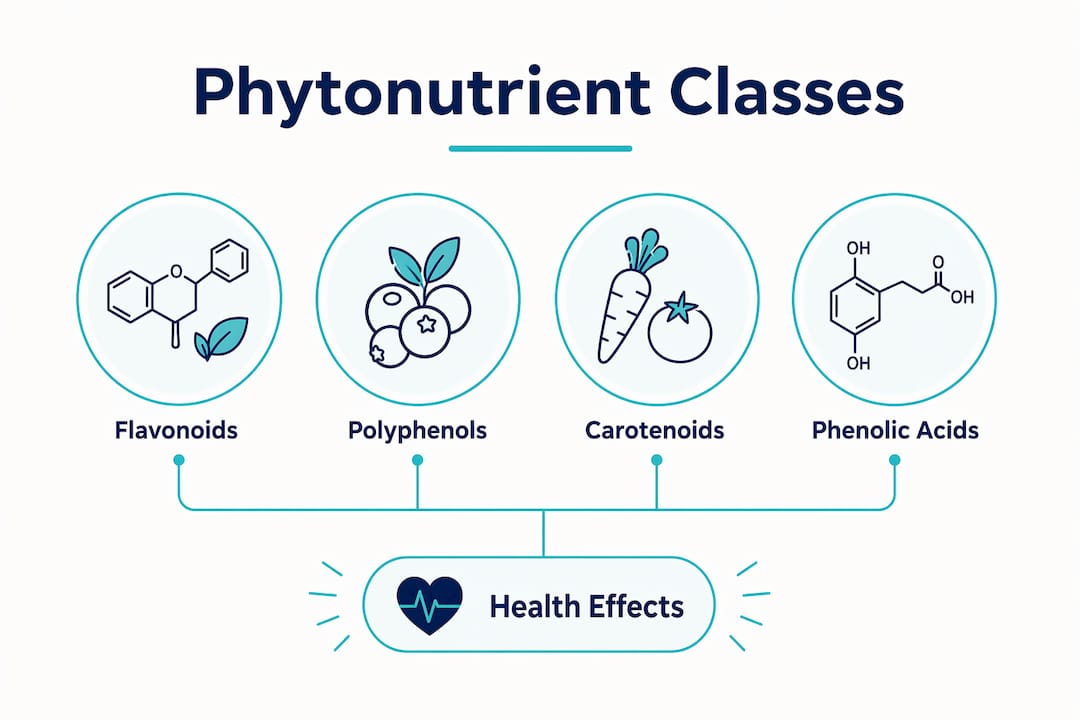
Flavonoids are the largest subgroup of polyphenols and appear in tea, citrus juice, berry juice, and wine. Catechins dominate green tea; theaflavins and thearubigins form during black tea oxidation. Anthocyanins give berry and grape juices their deep colour and are among the most studied flavonoids for cardiovascular and cognitive effects.
Polyphenols and phenolic acids cover a broader chemical family. Coffee’s chlorogenic acids are phenolic acids absorbed primarily in the small intestine, where they appear in circulation as glucuronide and sulfate metabolites. Phenolic acids also show up in apple juice, cranberry juice, and purple grape juice.
Carotenoids are the fat-soluble pigments responsible for orange, red, and yellow colours. Orange juice, carrot juice, and tomato juice are the main beverage sources. Because carotenoids are fat-soluble, bioavailability improves when consumed alongside a small amount of dietary fat.
Diverse phytonutrient blends in beverages tend to provide complementary health effects compared to single-source drinks, since different compound classes act through different biological pathways. Drinking only green tea, for example, gives you catechins but misses the carotenoids in a glass of carrot juice.
Phytonutrients are not classified as essential nutrients, yet they modulate immune responses, support DNA repair, and promote gut microbiome balance in ways that go well beyond basic nutrition.
What are the real health benefits of phytonutrient-rich drinks?
The evidence base for phytonutrient beverages is built primarily on observational studies and meta-analyses, and it is worth being clear about what that means. These studies consistently show associations between higher intake and better health outcomes. Rigorous randomised controlled trials confirming exact therapeutic doses are still catching up.
With that framing in place, the findings are genuinely compelling. Diets rich in flavonoids and phytonutrients from beverages are linked to lower metabolic syndrome risk and reduced all-cause mortality. The Zutphen Elderly Study found that a mean intake of 124 mg per day of monomeric flavan-3-ols, compared with 25 mg per day, was associated with a 51% lower 10-year coronary artery disease mortality. That amount is achievable with roughly 89 mL of tea.
Key finding: A typical serving of coffee or tea provides phytonutrient amounts exceeding those found in one cup of commonly consumed fruits and vegetables.
Additional benefits supported by the research include:
- Antioxidant activity — neutralising free radicals and reducing oxidative stress at the cellular level
- Anti-inflammatory effects — reducing markers associated with chronic inflammation and related disease progression
- Cardiovascular support — flavonoids help regulate cholesterol levels and support vascular function
- Metabolic benefits — chlorogenic acids in coffee are linked to improved insulin sensitivity and glucose utilisation
- Gut microbiome support — polyphenols act as prebiotics, feeding beneficial bacteria in the colon
A note on excess and contraindications: Excessive phytonutrient intake, particularly through concentrated supplements rather than whole beverages, can carry risks including potential adverse effects on cancer risk. Beverages consumed in reasonable daily amounts sit well within safe ranges for most people. Those on blood thinners, with hormone-sensitive conditions, or managing kidney disease should check with a healthcare provider before dramatically increasing intake of any single phytonutrient source.
Beverages versus whole foods: Whole foods deliver phytonutrients alongside fibre, vitamins, and minerals that beverages often lack. A glass of orange juice gives you flavonoids and vitamin C but not the fibre of a whole orange. Beverages are a practical complement to whole-food intake, not a replacement. More randomised trials are still needed to confirm optimal dosages for specific health outcomes.
Pro Tip: Pair carotenoid-rich juices like carrot or tomato with a small amount of healthy fat, such as a handful of nuts, to meaningfully improve absorption.
How are Canadians embracing functional phytonutrient drinks?
Canadian consumer interest in nutrient-dense, lower-sugar beverages has grown steadily, driven by a broader shift away from sugary sodas and conventional energy drinks. Public health guidance is moving in the same direction, with beverage recommendations increasingly favouring drinks that deliver phytonutrients without excess added sugar.
Functional sparkling beverages have emerged as one of the most practical formats for this shift. They offer carbonation and flavour without the sugar load of traditional sodas, and the best ones use natural plant-derived ingredients that carry genuine phytonutrient content. When reading labels, look for:
- Named botanical ingredients rather than vague “natural flavour” listings
- Low or no added sugar as a primary formulation goal
- Recognisable fruit or plant extracts that correspond to known phytonutrient sources
- Minimal artificial additives, which can interfere with the clean phytonutrient profile
Drinksolidviibe is a Canadian brand built around exactly this approach. Their sparkling beverages use functional flavours like lemon-ginger and passionfruit, ingredients with established phytonutrient and anti-inflammatory profiles, to deliver a refreshing drink that does not compromise on wellness. The antioxidant role in drinks is something Drinksolidviibe takes seriously at the formulation level, not just as a marketing claim.
For daily serving guidance, most research on phytonutrient beverages points to consistency over volume. Two to three servings of varied phytonutrient-rich drinks spread across the day, whether that is a morning coffee, an afternoon green tea, or a sparkling functional beverage, tends to outperform a single large dose. Variety across compound classes matters more than maximising any one source.

Ready to make the switch to a drink that actually works for you? The Solidviibe Sparkling Variety Pack gives you three functional flavours in one order, lemon-ginger, peach, and passionfruit, so you can find what fits your routine without committing to a single option.
Key takeaways
Phytonutrient beverages deliver plant-based bioactive compounds that support antioxidant defence, reduce inflammation, and are linked to lower chronic disease risk when consumed consistently as part of a varied diet.
| Point | Details |
|---|---|
| Top beverage sources | Green tea, black tea, coffee, and 100% fruit juice are the most studied phytonutrient-rich drinks. |
| Key compound classes | Flavonoids, polyphenols, phenolic acids, and carotenoids are the four major groups found in common beverages. |
| Cardiovascular evidence | Higher flavan-3-ol intake was linked to 51% lower 10-year coronary artery disease mortality in the Zutphen Elderly Study. |
| Supplement caution | Excessive phytonutrient intake via concentrated supplements can carry adverse effects; whole beverages in daily amounts are generally safe. |
| Variety over volume | Spreading two to three servings of different phytonutrient beverages across the day covers more compound classes than a single large dose. |


